River and Reservoir Drowning Prevention Monitoring Solution
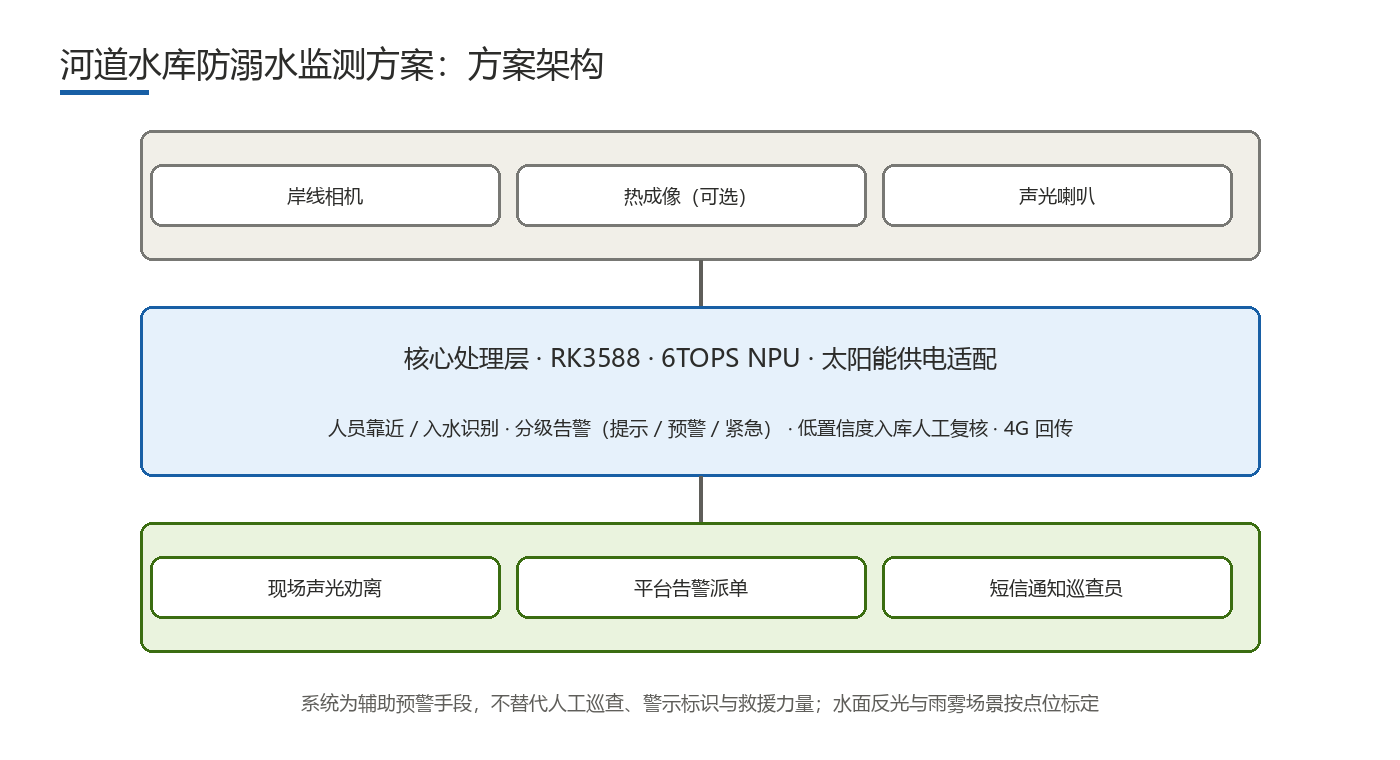
River and reservoir drowning prevention is best built on the RK3588 core board, where the goal is turning shoreline video into graded alarms that a duty officer can verify, not letting a single frame decide whether to dispatch rescue. The platform pairs a 4×A76 + 4×A55 CPU with a 6TOPS NPU, accepts visible-light and thermal cameras, and runs on-device detection for people entering water or approaching hazardous zones, with siren, broadcast and SMS linkage over solar power and 4G backhaul. Hongyin Tech provides a free requirement review and complete-device customization, with selection advice within 48 hours.
Pain Points
- Long, wide shorelines leave patrol staff outnumbered by monitoring points, especially in peak periods
- Night, heavy rain and fog cut visibility, leaving a very short window to spot a person in danger
- Water reflection, rain and night lighting cause false alarms, and duty staff grow numb to them
- Alarms sound only on site, with no notification path to a responsible person and no traceable outcome
- Most shoreline points have no mains power or fiber, so cabling is costly and slow to build
Recommended Hardware Configuration
| SoC platform | RK3588 (4×Cortex-A76 + 4×Cortex-A55); refer to the datasheet for details |
|---|---|
| AI computing power | 6TOPS NPU running on-device models for water entry and hazardous-zone approach |
| Memory & storage | Optional LPDDR4/LPDDR5 with eMMC, retaining alarm snapshots and short clips locally |
| Video input | MIPI CSI and Ethernet camera input, with optional visible-light plus thermal dual channels |
| Network & interfaces | 4G cellular with optional Ethernet; RS485 and digital I/O for speakers, sirens and water-level sensors |
| Enclosure & protection | Outdoor-rated enclosure with wide-temperature and surge protection, designed for solar panel plus battery power |
Software Capabilities
- Hazard detection: NPU models flag water entry and zone approach, with configurable warning lines and confidence grading
- Graded alarms: events split into notice, warning and emergency; low-confidence results are logged only, while warning and above go to the platform for review
- On-site deterrence: links sirens and speakers to preset voice prompts, with trigger limits to avoid disturbance
- Multi-channel notification: alarms pushed over MQTT/HTTP plus SMS and broadcast system linkage
- Store-and-forward: buffers alarm snapshots and clips during 4G outages and uploads them in time order after recovery
Deliverables & Services
- Requirement review (free): map monitoring points, water-body types, camera and power conditions, and define the graded alarm strategy and selection
- Hardware design: core board selection, carrier board customization, dual-spectrum camera interfaces and outdoor enclosure design
- BSP/drivers/algorithms: system trimming, camera and sensor driver adaptation, behavior model deployment and threshold tuning
- Prototype integration: build prototypes, run shoreline field tests, collect false-alarm samples and verify the platform alarm chain
- Low-volume and mass-production support: low MOQ, firmware upgrades, model iteration and continuous supply
FAQ
Q:Should a river drowning-prevention project use RK3588 or RK3576?
Choose RK3588 when visible-light and thermal cameras run multi-channel detection at the same time; RK3576 saves power and cost for single-camera sites dominated by scheduled snapshots and simple behavior detection. RK3588 is 4×A76 + 4×A55 and RK3576 is 4×A72 + 4×A53, both with a 6TOPS NPU; interface counts and codec channels follow the datasheet. Share your site count, camera channels and power options for advice within 48 hours.
Q:How are false alarms from water reflection, rain, fog and night handled?
These are the main false-alarm sources, so the design avoids single-frame decisions and grades results instead. Detections are split by confidence into notice, warning and emergency; low-confidence events are logged without triggering sirens, warning and above go to the platform for a duty officer to review the original image, and only emergency events activate sound-light deterrence. Angling cameras away from the reflection band and cross-checking with thermal at night cuts false alarms noticeably.
Q:What makes up the cost of a drowning-prevention monitoring system?
Cost is driven by the number of points, camera configuration, power method and platform integration effort. A single visible-light camera with 4G backhaul is the lowest-cost build; thermal imaging, solar power, sirens and broadcast linkage each add cost, and connecting to an existing water or emergency platform adds protocol adaptation and commissioning. Start with a free requirement review to fix the point list, then estimate line by line rather than quoting a headline price.
Q:How does the system integrate with water or emergency platforms, and how is rollout scheduled?
The device outputs alarms and video over common paths such as MQTT, HTTP and GB/T 28181, with the actual interface aligned to the technical documents of the existing water, emergency or scenic-area platform and commissioning done jointly by both engineering teams. Rollout typically moves through site survey, prototype validation, a small pilot and phased expansion, paced by point count and power construction. Note that the system assists early warning and does not replace patrols, warning signage or rescue teams.
Related Technical Articles
Share your scenario and requirements — free requirement review, selection advice within 48 hours.
Get a Free Quote →