Rail Transit Onboard Monitoring and Passenger Information Terminal Solution
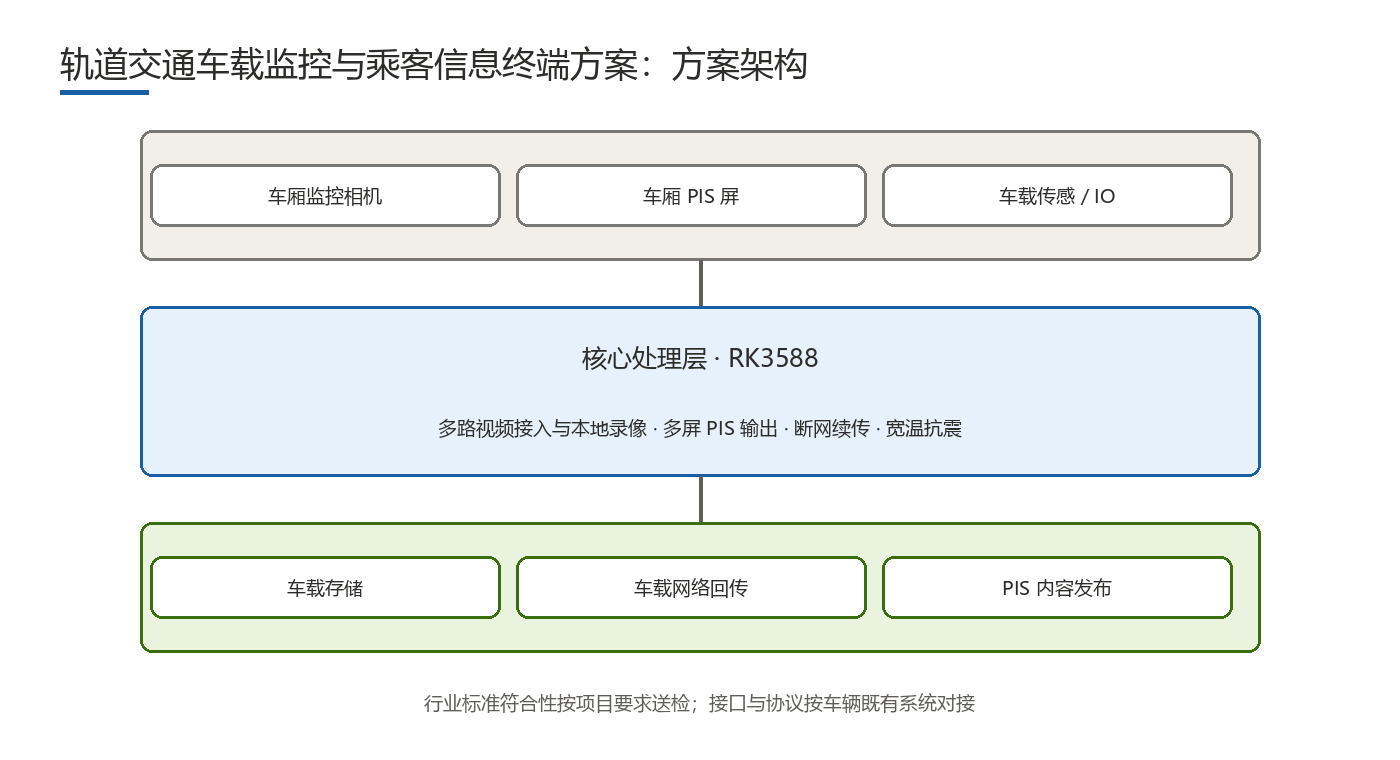
Subway, tram and intercity trains need onboard terminals that record multiple carriage cameras locally, drive passenger information displays with arrival and service content, and keep recording intact through tunnel dead zones. Built on the RK3588 core board, this solution covers multi-channel video input with local storage, PIS multi-screen output, store-and-forward upload and a wide-temperature, vibration-resistant design. Safety-related certification is submitted per project-required industry standards. Send us your project spec and get selection advice within 48 hours.
Pain Points
- Multiple carriage video streams write concurrently, and ordinary controllers drop frames and break recordings
- Links fail in tunnel dead zones, causing gaps in recorded video and operational data
- Passenger information screens vary in resolution and interface, making synchronized multi-screen output hard to adapt
- Onboard temperature and humidity swings plus continuous vibration undermine long-term board stability
- Project requirements are diverse with tight schedules, demanding fast customization of the controller and interfaces
Recommended Hardware Configuration
| SoC platform | RK3588 core board (4×Cortex-A76 + 4×Cortex-A55) for parallel multi-channel video and multi-screen output |
|---|---|
| Video input & storage | Multi-camera input with local storage; eMMC plus expandable storage to meet recording capacity planning |
| Display output | Multiple HDMI/DP/MIPI outputs supporting independent multi-screen passenger information display |
| Network & communication | Gigabit Ethernet with 4G/5G module interfaces for train-to-ground transfer and store-and-forward |
| Vehicle interfaces | CAN, multiple serial ports and GPIO to interface vehicle signals and station announcement linkage per project |
| Structure & power | Wide-temperature components, vibration-resistant structure and wide-voltage onboard power design |
Software Capabilities
- Multi-channel recording: concurrent recording, loop overwrite and power-loss protection to keep video continuous
- PIS content publishing: arrival information, service announcements and display template management with multi-screen distribution
- Store-and-forward: local buffering during tunnel outages with automatic, de-duplicated upload once the train-to-ground link recovers
- Vehicle signal integration: interfacing vehicle bus and digital signals per project to drive announcements and screen content
- Stability and O&M: watchdogs, process supervision and remote upgrade with remote health monitoring
Deliverables & Services
- Free requirement review: confirming camera channels per carriage, recording duration, PIS screen count and project standards
- Hardware design: core board selection, carrier board for multi-channel video and multi-screen output, plus vibration and power design
- BSP/driver/algorithm: OS customization, camera and display drivers, recording and store-and-forward feature development
- Prototype integration: in-carriage testing of recording continuity, multi-screen synchronization and offline resume behavior
- Pilot and mass production: phased delivery by train consist, with support for certification submission and production testing
FAQ
Q:Has this onboard monitoring solution already passed rail transit certification?
The solution provides the controller hardware platform and software functions for onboard monitoring and information display terminals. Safety-related certification is submitted per the industry standards required by each project, and we support it with the necessary technical documentation and samples. Whether certification is obtained, and its scope and timing, depend on the specific project — we do not claim certification by default.
Q:How should recording channels and storage capacity be planned for carriage video?
Channel count depends on how many cameras each carriage has and whether recording is grouped, while capacity is driven by channels, resolution, frame rate, bitrate and retention days. Define retention days and image quality first, then work back to daily capacity and free-space margin from the bitrate. Send us your camera configuration and retention requirements for a free review and a channel and capacity plan within 48 hours.
Q:Which interfaces can be used for multi-screen passenger information output?
Display interfaces such as HDMI, DP and MIPI can be combined per project, with screens running identical or independent content for passenger displays, carriage-end screens and cab monitoring panels. The exact channel and resolution combinations are constrained by chip specifications (refer to the chip datasheet), and feasible configurations can be confirmed against your screen list during the requirement review.
Q:Will recordings be lost during tunnel outages, and how is the backlog uploaded afterwards?
Video is written to local storage first, so a tunnel outage affects only uploads, not recording — the local footage stays complete. Once the link recovers, the system uploads the backlog in time order with de-duplication checks to avoid duplicate files. Upload progress and link status are visible to O&M staff for verifying data integrity as the project requires.
Related Technical Articles
Share your scenario and requirements — free requirement review, selection advice within 48 hours.
Get a Free Quote →