Embedded Device Security Hardening: Secure Boot, Signing, and Encryption
Embedded hardening starts with a threat model, not tool selection: grade the attack surface and rank threats by ease of exploitation times impact. The usual order is to close debug interfaces, fix default credentials, then add secure boot and signing, and finally encryption.
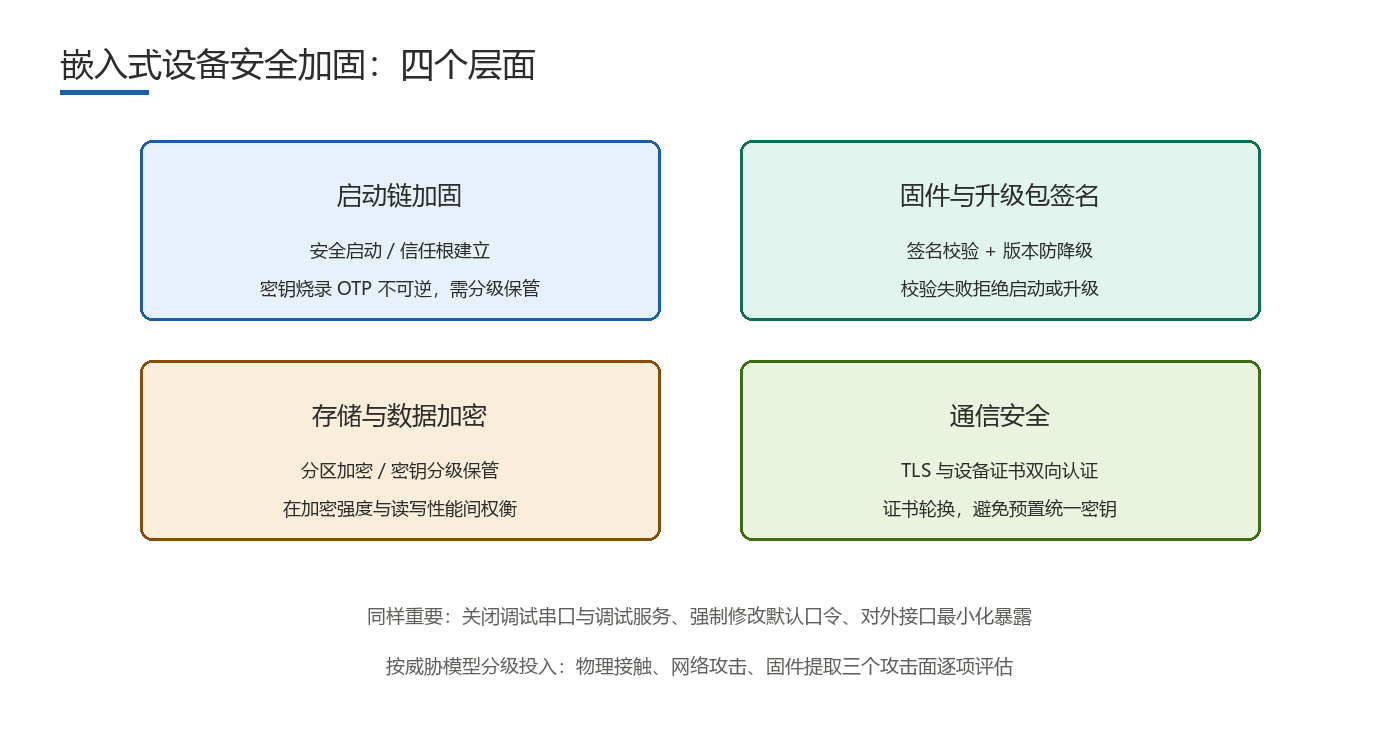
Where Should Hardening Start?
The starting point is a threat model, not a product list. List who would attack the device and how, across four categories:
- Physical access: attaching to a debug UART or reading the storage chip to extract images and keys.
- Network: exposed ports, weak credentials, unencrypted traffic, and exploitable protocols.
- Firmware extraction: dumping the image to study logic or find hardcoded credentials.
- Supply chain: leaking signing keys, images escaping a contract manufacturer, or firmware implanted in repair.
Grade each surface by ease of exploitation and impact, then tackle the low-difficulty, high-impact combinations first. Close the easy doors before worrying about what a visitor takes inside.
Secure Boot and a Root of Trust
Secure boot chains trust: immutable code verifies the next stage's signature, refusing to boot if any stage fails. Three points matter:
- Keys in OTP/eFuse are one-time and irreversible: once burned and enabled, the key is fused into the chip. Verify and back it up first; a wrong burn can scrap a batch.
- Key hierarchy: root keys offline and cold, production signing keys access-controlled and distributed by least privilege.
- Production flashing: isolate the environment, keep keys in a secure boundary, and route repair flows through the same checks.
Secure boot ensures only trusted firmware runs; it does not cover runtime vulnerabilities or data protection, so pair it with those measures. Implementations follow the vendor's official datasheet.
How Do You Sign Firmware and Update Packages?
- Bind signatures to versions: include a version number or counter so a signed high-version image cannot be swapped for a lower one to roll back to a vulnerable build.
- Anti-rollback: record the installed version and reject images below it unless the device enters factory mode.
- Reject on failure: a failed check must refuse installation and leave the current system usable — never "flash first and see."
Signing covers authorization, not transport or process; download, write, and rollback belong to the upgrade flow. For rotation, ship old and new public keys together, then sign with the new key once the fleet updates.
How Do You Encrypt Storage and Data?
- Partition encryption: encrypt sensitive partitions end to end, with the kernel handling I/O; system partitions need integrity more than confidentiality.
- Where keys live: keys must not sit in plaintext on an unencrypted partition. Prefer a hardware security module or the chip's built-in key store, decrypting inside a TEE.
- Encryption versus performance: full-disk encryption adds read/write overhead, especially at boot. Encrypt only sensitive partitions and evaluate a hardware crypto engine.
Measure the performance impact and confirm hardware crypto support. Once live, a lost key means unrecoverable data, so design key backup alongside the scheme.
Communication Security and Device Hardening
- TLS and device certificates: use TLS with server-certificate validation to prevent man-in-the-middle attacks; high-assurance scenarios add mutual authentication.
- Pre-shared key risks: one key shared across all devices is a fleet-wide risk if leaked; move toward per-device keys and a rotation channel.
- Disable debug interfaces: production firmware disables debug UARTs and services or adds access control — a high-return step.
- Defaults, logs, interfaces: force a default-password change; never log plaintext keys and support remote removal; open only needed ports.
Operations needs two companions: a vulnerability-response and firmware-recall process and auditing and traceability. Hardening is continuous.
How Much Does Hardening Cost?
Hardening follows a cost curve and need not all be done at once. The table gives typical trade-offs by tier:
| Layer | Typical measures | Cost and complexity | Best-fit scenario |
|---|---|---|---|
| Device itself | Close debug ports, change defaults, minimize interfaces, redact logs | Low — mostly config and firmware trimming | All connected devices; do this first |
| Boot chain | Secure boot, root of trust, key burning to OTP/eFuse | Medium-high — key management and production changes | Devices needing anti-tamper and anti-clone |
| Firmware and data | Firmware signing, anti-rollback, partition encryption | Medium — changes the release chain and storage | Sensitive data or anti-replacement needs |
| Comms and operations | TLS, mutual auth, per-device keys, vulnerability response | Medium — touches cloud and operations | Connected products with long-term operations |
Invest top-down: do low-cost, high-return device hardening first, then decide on secure boot and encryption from the threat model. Match the security tier to product value and attacker motivation: heavy schemes on a low-value device raise cost for little gain, while skimping on the boot chain for a high-value device can lose everything to one leak.
FAQ
- Q1: Is firmware signing useful without secure boot?Partly — it blocks unauthorized firmware, but if an attacker bypasses the boot chain and flashes directly, signing is defeated.
- Q2: Can a key in OTP/eFuse be changed later?Usually not. Such storage is one-time and irreversible, so verify the key and keep an offline backup before burning; a mistake can scrap a batch.
- Q3: Does encryption slow the system down?It adds read/write overhead depending on partition size, access patterns, and hardware crypto. Encrypt only sensitive partitions and measure the impact.
- Q4: Should hardening be done all at once?No. Rank by ease of exploitation times impact, do the cheap high-return measures first, then add more from the threat model.
Hongyin Tech provides full-stack SoM/SBC customization on Rockchip & HiSilicon platforms with Android/Linux. Engineers respond within 1 business day.
Get a Free Quote →