Scenic Area Visitor Flow Analytics and Dispatch Solution
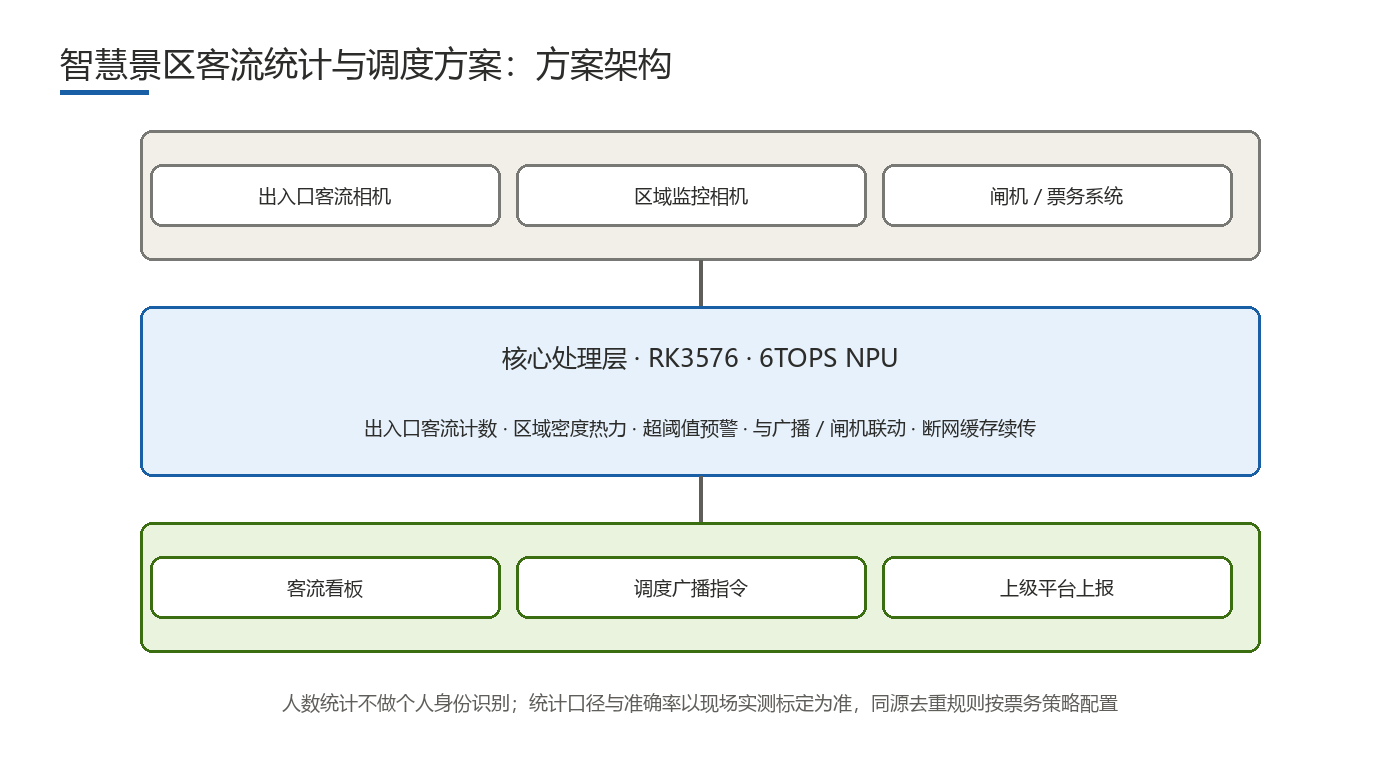
Visitor flow analytics at scenic areas needs local counting at entrances and key zones, which an RK3576 edge terminal handles on site. The platform pairs 4×A72 + 4×A53 cores with a 6TOPS NPU, ingesting stereo, ToF or video head-detection streams, counting both directions and building zone density heatmaps that trigger alerts and drive broadcast, gate and ticketing linkage. Counting only measures people, never faces; deduplication rules follow ticketing and time windows, and accuracy is verified by on-site calibration. Hongyin Tech offers a free requirement review and complete-device customization, with selection advice within 48 hours.
Pain Points
- Holiday surges leave entrance queues and zone congestion without quantified evidence
- Manual counters drift, and shift changes produce inconsistent figures across locations
- Zone density is judged by experience, so over-capacity warnings and flow control lag behind
- Broadcast, gates and ticketing operate separately, making dispatch slow and hard to close the loop
- Unstable networks in mountainous areas and at temporary entrances leave data gaps that cannot be reconciled
Recommended Hardware Configuration
| SoC platform | RK3576 (4×Cortex-A72 + 4×Cortex-A53); refer to the datasheet for details |
|---|---|
| AI computing power | 6TOPS NPU with parallel head-detection inference across channels and per-zone model loading |
| Memory & storage | LPDDR4/LPDDR5 with eMMC, storing counts and event data locally during network outages |
| Video input | Stereo or ToF people-counting cameras and Ethernet IP cameras, multi-channel decoding; channel count per the datasheet |
| Network & interfaces | Gigabit Ethernet with 4G/5G backup, RS485 and relay outputs for gate and broadcast linkage |
| Enclosure & protection | Indoor/outdoor metal enclosure with wide-temperature design and sun/rain shielding at entrances (IP rating per device testing) |
Software Capabilities
- Entrance counting: stereo, ToF or video head detection counts entry and exit directions separately and outputs minute-level curves
- Deduplication and calibration: merges repeat entries by ticketing and time-window rules, corrects through on-site calibration and verifies error by reconciliation
- Zone density heatmaps: grid-based headcount and density with heatmaps and alerts for zones above threshold
- Dispatch linkage: integrates with broadcast, gates and ticketing to trigger flow control, diversion announcements and staffing plans
- Offline buffering and upload: stores counts and events locally, resumes upload with timestamp alignment to avoid double counting
Deliverables & Services
- Requirement review (free): map entrances, key zones, ticketing rules and linkage targets, then deliver selection and deployment advice
- Hardware design: core board selection, carrier board and interface customization, entrance mounting structure and power design
- BSP/drivers/algorithms: camera integration and driver adaptation, counting model deployment, deduplication rules and calibration tooling
- Prototype integration: on-site installation and calibration, peak-flow validation, and broadcast, gate and ticketing integration
- Low-volume and mass-production support: low MOQ, batch parameter rollout and remote firmware upgrade maintenance
FAQ
Q:Should scenic-area counting use stereo cameras, ToF or video analytics?
For structured entrance lanes where direction matters, stereo or ToF is preferred because it is less affected by lighting; video head detection suits large areas and retrofits of existing surveillance. Deployments often mix both, with RK3576 aggregating all inputs. Channel counts and interfaces follow the datasheet and camera specs; share your layout for free selection advice.
Q:How are repeat entries by the same visitor deduplicated?
Deduplication starts with clear business rules: merge by ticket validity, by time window, or by paired entrance and exit. The edge device records direction and timestamps, computes in-park headcount under the agreed rules, and reconciles against ticketing data. No fixed accuracy figure is promised; results are verified through on-site calibration and peak-period reconciliation.
Q:What makes up the cost of a scenic-area visitor flow project?
Cost comes from camera count and type, edge terminal configuration, poles, power and cabling, cellular data, and integration effort with broadcast, gates and ticketing. Mountainous locations and solar power can noticeably affect the budget. A free requirement review defines locations and linkage scope, and we estimate against the configuration without inflated pricing.
Q:Does visitor counting involve face recognition, and how is compliance addressed?
The solution counts people only, performs no face recognition and creates no identity linkage. Detection runs at the edge, with only counts and event clips retained, while raw video is kept per project agreement or not uploaded at all. Where local rules require filing for public-area video collection, the project follows those rules and the applicable local regulations.
Related Technical Articles
Share your scenario and requirements — free requirement review, selection advice within 48 hours.
Get a Free Quote →