Open Kitchen and Food Safety Monitoring Solution
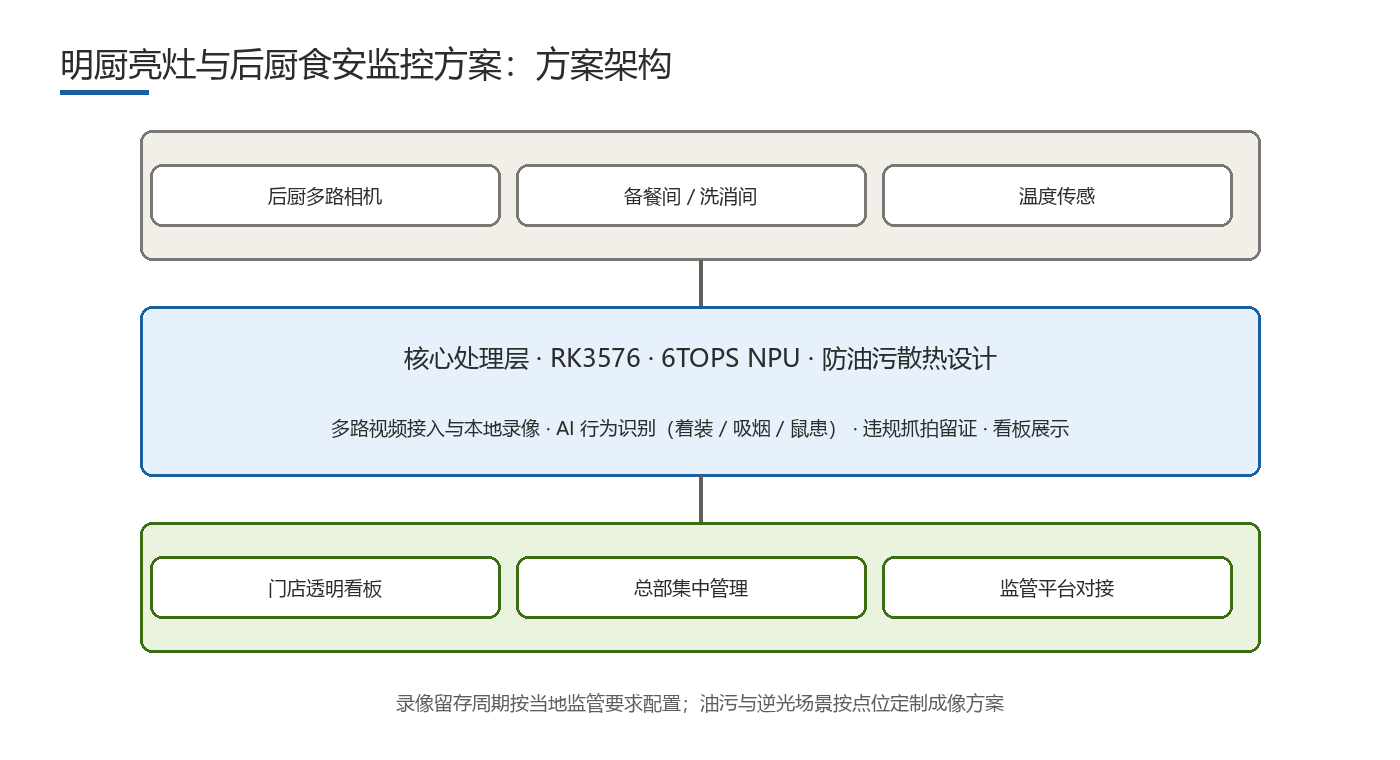
Kitchen food-safety inspection is best handled by an edge terminal running recognition locally, and RK3576 keeps control in hot, greasy kitchens better than a cloud-only design. The platform pairs 4×A72 + 4×A53 cores with a 6TOPS NPU, ingests multiple video channels with local recording, and runs mask, cap, smoking, phone-use and rodent models, capturing evidence and pushing it to store dashboards and headquarters. Video and data are integrated per local regulator requirements, with retention set to local rules. Hongyin Tech offers a free requirement review and complete-device customization, with selection advice within 48 hours.
Pain Points
- Heavy grease and high temperatures cause ordinary devices to throttle or crash from poor heat dissipation
- Manual inspection is infrequent, so violations after closing or during peak service go unnoticed
- Missing masks or caps and smoking lack continuous records, making corrective evidence hard to produce
- Local regulator platforms differ in interface and video format requirements, forcing repeated rework
- With many dispersed stores, headquarters struggles to review, assess and trace responsibility consistently
Recommended Hardware Configuration
| SoC platform | RK3576 (4×Cortex-A72 + 4×Cortex-A53); refer to the datasheet for details |
|---|---|
| AI computing power | 6TOPS NPU with parallel multi-channel inference and per-store behavior model configuration |
| Memory & storage | LPDDR4/LPDDR5 with eMMC for local loop recording; retention days configured per local regulatory requirements |
| Video input | Multi-channel Ethernet IP camera input with RTSP pull and stream-reconnect; channel count per the datasheet |
| Network & interfaces | Gigabit Ethernet as primary link with 4G backup, HDMI local dashboard output and RS485 peripheral expansion |
| Enclosure & protection | Fanless aluminium enclosure with grease-resistant surface treatment and wide-temperature design; thermal design evaluated for hot, greasy kitchens |
Software Capabilities
- Multi-channel input and local recording: RTSP decoding with automatic reconnect, daily loop coverage and time-based search
- AI behavior detection: mask, cap, smoking, phone use, stranger entry and rodent activity, enabled per area
- Violation evidence capture: stores snapshots plus pre/post clips with time, location and rule name for corrective review
- Store dashboard and HQ management: local HDMI dashboard for live view and alarms, with remote rule configuration and firmware upgrade at headquarters
- Regulator platform integration: pushes video streams and alarm data per local open-kitchen platform requirements, with interface documents delivered per project
Deliverables & Services
- Requirement review (free): confirm store count, camera locations and violation rule list, then deliver selection and regulator integration advice
- Hardware design: core board selection, carrier board customization, grease-resistant enclosure and thermal design
- BSP/drivers/algorithms: system trimming, camera and network driver adaptation, behavior model training and deployment
- Prototype integration: on-site store installation tests, image tuning for backlight and reflective surfaces, and platform integration
- Low-volume and mass-production support: low MOQ, batch configuration rollout and remote firmware upgrade maintenance
FAQ
Q:Is RK3576 enough for an open-kitchen project, and when is RK3588 needed?
RK3576 is sufficient for four to eight channels per store with a few behavior models, since its 4×A72 + 4×A53 cores and 6TOPS NPU run inference in parallel. Evaluate RK3588 when one device must handle a dozen or more channels with several models at once, or drive multiple displays. Codec channel counts follow the datasheet; share your camera layout for free selection advice.
Q:How do devices stay reliable in greasy, hot kitchens?
The fanless aluminium enclosure with grease-resistant surface treatment conducts heat through the case and avoids fans that would draw in oil mist. Mounting should avoid directly above stoves and steam vents, with a grease shield where needed. Wide-temperature behavior and thermal margin are assessed on site, validated by continuous prototype runs, and the final ingress rating depends on device testing.
Q:How is centralized O&M handled across many stores?
Store terminals connect to the HQ platform over Ethernet or 4G, centralizing device status, video preview, rule configuration and firmware versions. Alarms are aggregated by store, area and rule, and headquarters can issue corrective tasks. During outages, recognition and recording continue locally and upload resumes afterwards, avoiding data gaps from unstable store networks.
Q:How long should open-kitchen video be retained, and how is it connected to a local regulator platform?
Retention is configured to local regulatory requirements, commonly daily loop coverage with separate archiving of violation clips, and the exact period follows local rules. The device supports standard video streams and structured alarm reporting, with format and signaling integrated per the local platform's technical documents. Share the interface documents during the requirement review and our engineers will support integration.
Related Technical Articles
Share your scenario and requirements — free requirement review, selection advice within 48 hours.
Get a Free Quote →