Inspection Robot Controller and Vision Solution
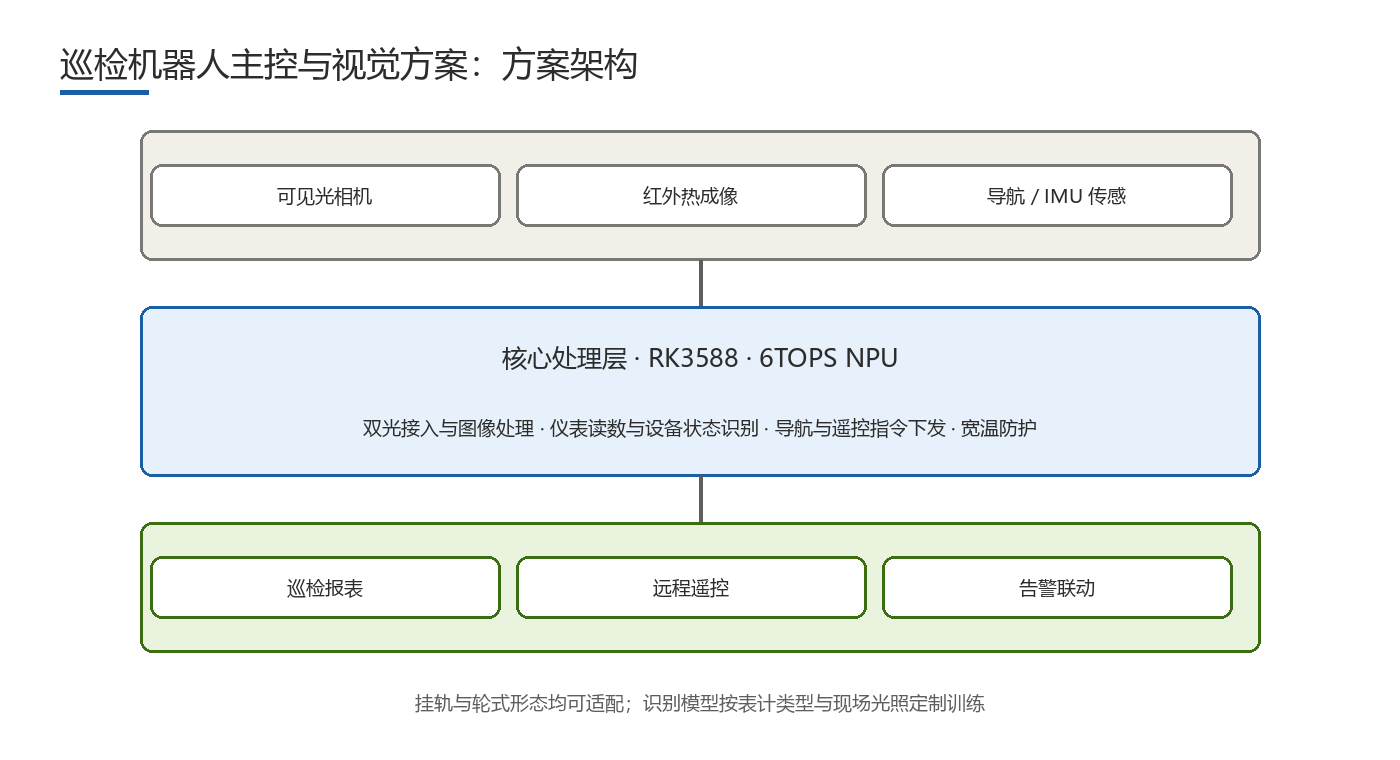
Rail-mounted and wheeled inspection robots patrol distribution rooms, utility tunnels and plants, streaming both visible-light and thermal imagery while reading meters, recognizing equipment status and supporting remote teleoperation. Built on the RK3588 core board (4×A76 + 4×A55, 6TOPS NPU), this solution covers dual-spectrum camera input, NPU vision recognition, navigation and teleoperation links plus wide-temperature ruggedization. Delivered in modules with prototype integration and pilot support — send us your duty scenario and get selection advice within 48 hours.
Pain Points
- Synchronizing visible-light and thermal streams is tricky, and image registration takes significant effort
- Meters vary widely in type and dial style, making reading algorithms hard to generalize
- One controller must run navigation, recognition and teleoperation at once, so compute and power are hard to balance
- Distribution rooms and tunnels bring wide temperature and humidity swings plus dust, causing board instability
- Interface needs are scattered, requiring reserved Ethernet, serial, CAN and gimbal control ports
Recommended Hardware Configuration
| SoC platform | RK3588 core board (4×Cortex-A76 + 4×Cortex-A55) for concurrent vision and navigation tasks |
|---|---|
| AI computing power | 6TOPS NPU running meter reading, switch-state and appearance-defect models locally |
| Memory & storage | LPDDR4/LPDDR5 and eMMC sized by channel count and recording needs, retaining local inspection records |
| Camera input | Dual-spectrum input for visible-light cameras and thermal modules, with interfaces and power tailored to the robot |
| Motion & interfaces | Gigabit Ethernet, multiple serial ports, CAN and GPIO for chassis, gimbal and sensor modules |
| Structure & thermal | Wide-temperature design, fanless cooling and reinforced connectors for outdoor and semi-enclosed tunnels |
Software Capabilities
- Dual-spectrum video: synchronized capture and registration of visible-light and thermal streams for linked viewing
- Vision recognition: NPU-based models for meter reading, switch and indicator states, and appearance defects
- Navigation and teleoperation: integration with your navigation module and chassis protocol, with teleoperation link and live video return
- Inspection records and alerts: structured recognition output, per-point inspection records and anomaly alert push
- System and O&M: OS trimming, watchdog supervision, remote upgrade and over-the-air diagnostics
Deliverables & Services
- Free requirement review: defining inspection points, meter types, locomotion mode and teleoperation needs
- Hardware design: core board selection, carrier board for dual-spectrum cameras and chassis interfaces, plus structure and thermal design
- BSP/driver/algorithm: OS customization, dual-spectrum camera drivers, model training and NPU deployment
- Prototype integration: on-site accuracy testing with tuning of navigation linkage, teleoperation latency and temperature rise
- Pilot and mass production: phased production by robot model, with production test plans and long-term supply support
FAQ
Q:Why choose RK3588 for an inspection robot controller, and when is RK3576 enough?
Inspection robots typically run dual-spectrum video, vision recognition, navigation and teleoperation together, a multi-task load that RK3588 (4×A76 + 4×A55, 6TOPS NPU) handles more comfortably in parallel. If the robot only does single-spectrum recognition with few channels and is cost or power sensitive, RK3576 (4×A72 + 4×A53, 6TOPS NPU) can be evaluated. Share your inspection points and recognition needs for a free review and selection advice.
Q:What accuracy can meter reading recognition reach?
Accuracy depends on meter type, camera angle and lighting, and varies significantly between analog gauges and digital meters. We improve results through on-site sample collection, per-point training and periodic sample feedback iteration, and mark low-confidence results for manual review instead of trusting them directly. We recommend acceptance testing in the target scene and defining acceptance criteria from measured data.
Q:Can our existing navigation module and chassis connect directly?
Yes. The controller provides Gigabit Ethernet, multiple serial ports and CAN, and your navigation module and chassis connect using their existing protocols; we handle interface adaptation plus teleoperation link and video return integration. For proprietary protocols, sharing the protocol document is enough to assess the adaptation approach.
Q:How is controller reliability ensured in harsh distribution rooms and tunnels?
The hardware uses wide-temperature components, fanless cooling and reinforced connectors to reduce dust and vibration failures, while software provides watchdogs, automatic recovery and power-loss protection. The actual operating temperature range and ingress protection depend on the final structure and measured results; high-temperature, high-humidity and long-duration run tests can be arranged during the prototype stage.
Related Technical Articles
Share your scenario and requirements — free requirement review, selection advice within 48 hours.
Get a Free Quote →