Smart Construction Site Safety Monitoring Solution
Site safety monitoring works best when recognition runs locally on site; an RK3588 edge box is more reliable than streaming every channel to a central cloud. The platform pairs 4×A76 + 4×A55 cores with a 6TOPS NPU and runs hard-hat, reflective-vest, danger-zone intrusion, smoke and fire models concurrently, linking snapshot events to sound-light alarms while reporting over 4G/5G with local buffering. Detection results support safety prompts and evidence collection and do not replace on-site safety management responsibilities. Hongyin Tech offers a free requirement review and complete-device customization, with advice within 48 hours.
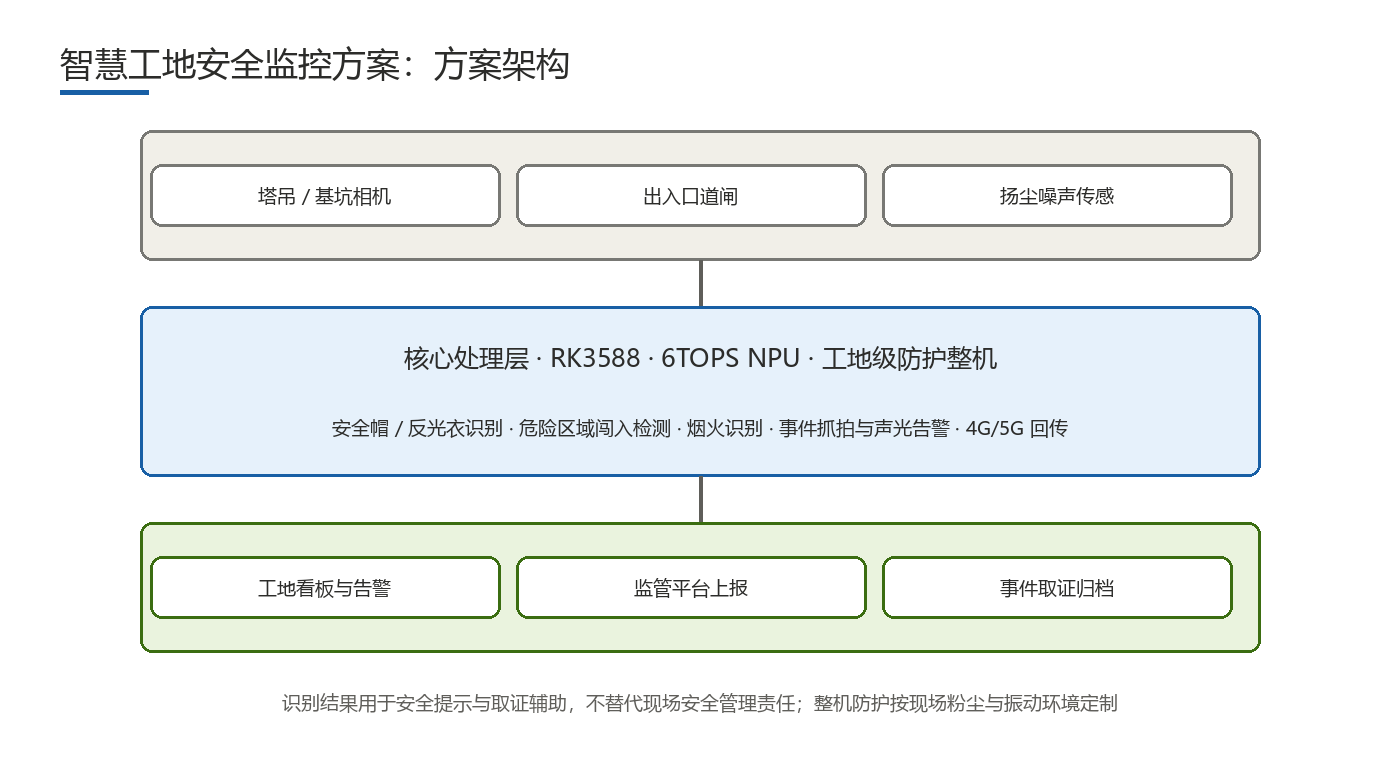
Pain Points
- Site locations are scattered and temporary, making wired network and mains power difficult
- Manual safety patrols cannot cover night shifts and multiple parallel work sections
- Missing hard hats and excavation intrusion are found late, with little basis for on-site stop-work
- Event video sits in separate subcontractor systems, complicating evidence collection and traceability
- General contractor and subcontractor systems are siloed, so workforce and alarm data cannot be aggregated
Recommended Hardware Configuration
| SoC platform | RK3588 (4×Cortex-A76 + 4×Cortex-A55); refer to the datasheet for details |
|---|---|
| AI computing power | 6TOPS NPU with parallel inference across channels and per-workface model switching |
| Memory & storage | LPDDR4/LPDDR5 and eMMC configured per project, with local recording and outage buffering |
| Video input | Ethernet IP camera input with multi-channel decoding and local recording; channel count subject to the datasheet and device configuration |
| Network & interfaces | 4G/5G cellular and Gigabit Ethernet, with RS485 and relay outputs for sound-light alarm linkage |
| Enclosure & protection | Fanless metal enclosure with dust-resistant, wide-temperature design; ingress rating selected for dusty sites (IP rating per device testing) |
Software Capabilities
- Hard-hat and vest detection: per-frame worker detection with rules configured by workface and time window, producing snapshots
- Danger-zone intrusion: virtual fences around excavations, edges and lifting areas trigger alarms and tag the related video clips
- Smoke and fire detection: on-device inference on smoke and flame features, with brightness-change logic to suppress lighting and dust false alarms
- Worker counting and attendance: entrance and workface counts feed on-duty duration and peak-headcount reports
- Alarm linkage and backhaul: local snapshot retention, sound-light and relay output, 4G/5G reporting with store-and-forward
Deliverables & Services
- Requirement review (free): map site distribution, network conditions and recognition scenarios, then deliver selection and deployment advice
- Hardware design: core board selection, carrier board and interface customization, dust-resistant wide-temperature enclosure and power design
- BSP/drivers/algorithms: system trimming, camera and 4G/5G driver adaptation, model quantization and deployment
- Prototype integration: build prototypes, run on-site trials, and verify alarm linkage and platform integration
- Low-volume and mass-production support: low MOQ, batch flashing and testing, plus remote firmware upgrade maintenance
FAQ
Q:Should a smart construction site use RK3588 or RK3576?
Choose RK3588 when many video channels run multiple behavior models in parallel, since its 4×A76 + 4×A55 cores and 6TOPS NPU leave more headroom; RK3576 controls cost for fewer locations with a single recognition task. Both support on-device inference and 4G/5G backhaul, and exact codec channel counts follow the datasheet. Share your site and channel count for free selection advice.
Q:What drives the cost of a construction site safety monitoring solution?
Cost is driven by camera count and type, edge box configuration, cellular data plans, pole and power installation, plus the number of recognition models and platform integration effort. Temporary power locations may also need solar or battery options. A free requirement review defines the scope, and we estimate against the actual configuration without inflated pricing.
Q:How is the solution deployed where site network and power are poor?
The edge box reports over 4G/5G while caching video and alarms locally, then uploads automatically once the link recovers, so short outages do not interrupt recognition or recording. Power can combine mains, solar or battery, and the device is built for dusty, wide-temperature sites. Deployment starts with a site survey to fix pole, power and backhaul design, validated during prototyping.
Q:Can detection results be used directly as a basis for safety penalties?
No. Detection results are intended for safety prompts and evidence assistance and do not replace on-site safety management responsibilities. The system provides time-stamped snapshots and clips for supervisors to review before action, false alarms require human confirmation, and final judgment follows the project's safety management rules. Alarm thresholds and review workflow are agreed during integration.
Related Technical Articles
Share your scenario and requirements — free requirement review, selection advice within 48 hours.
Get a Free Quote →