RV1126 vs RK3588 for Camera Designs: Front-End IPC or Smart Terminal
RV1126 and RK3588 are camera platforms with different roles: RV1126 targets front-end IPC with the imaging pipeline and encoding at its core, while RK3588 targets back-end and terminal devices that need multi-channel ingest and high general-purpose compute. Choose by product form and engineering capability, not by benchmarks.
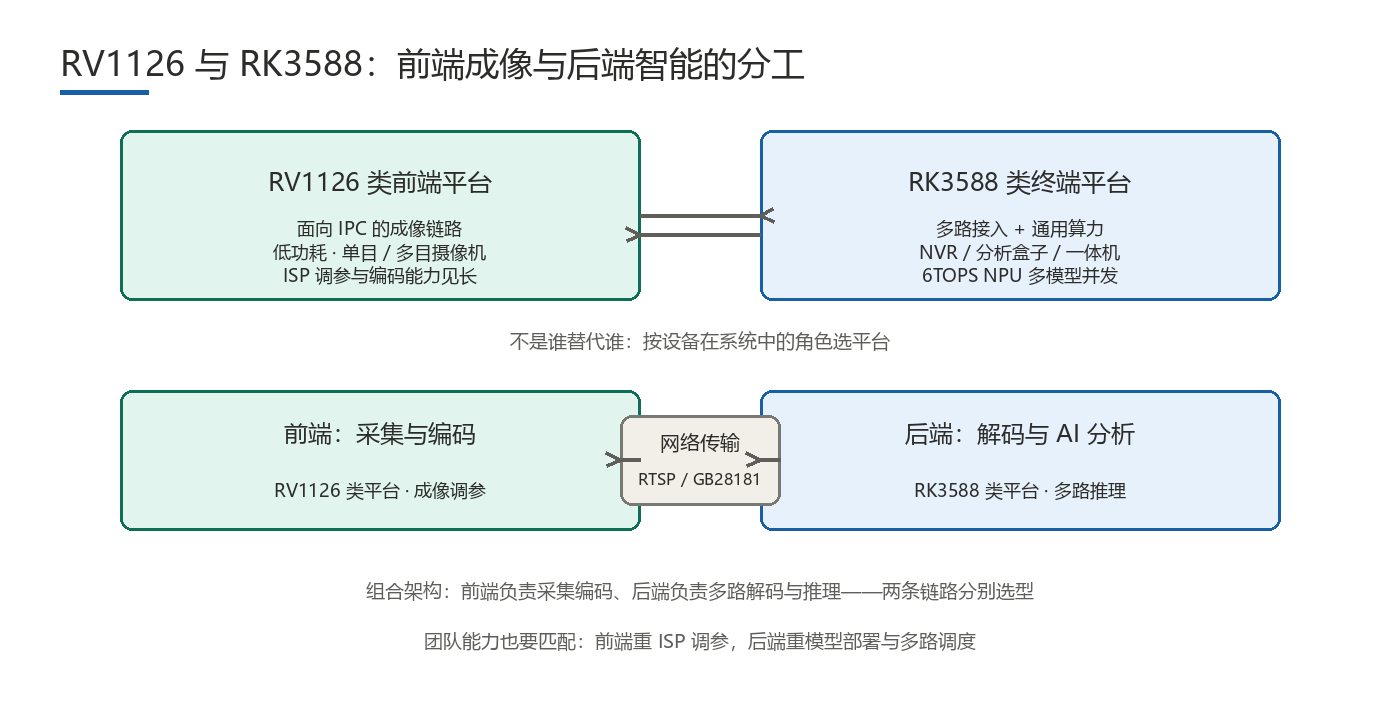
Where Do RV1126 and RK3588 Differ in Positioning?
RV1126 is Rockchip's front-end vision platform for IPC, with strengths in the imaging pipeline and video encoding, and power and cost structures suited to single-sensor or few-channel front-end cameras. RK3588 is a general high-performance platform with published specs of 4x A76 plus 4x A55 cores, a 6TOPS NPU, 8K decoding, and multiple display outputs, positioned for terminals that aggregate many video channels, run AI analytics, and drive multiple screens. Detailed parameters for both follow the official vendor datasheet.
Working backward from product form makes it concrete: dome, bullet, and multi-sensor panoramic cameras sell on image quality, and their core chain runs from sensor to ISP to encoding, which is front-end territory. NVRs, decoding video-wall appliances, and edge analytics boxes sell on channel count and compute, and their core chain runs from decode to display and inference, which is back-end territory. Place your product on that chain and the positioning difference becomes obvious.
Which Dimensions Should the Comparison Cover?
| Dimension | RV1126-class front-end | RK3588-class terminal |
|---|---|---|
| Product form and positioning | Single or multi-sensor front-end cameras, low-power IPC | NVR, analytics box, all-in-one, multi-screen terminal |
| Compute and video inputs | Imaging and encoding focused, fewer input channels | Multi-channel ingest, strong general compute, suited to concurrent models |
| Codec emphasis | Encode-centric, serving single-unit output | Decode and display weighted, serving aggregation and video wall |
| Power and thermals | Low power, often fanless | Higher power, needs active cooling and mechanical design |
| OS ecosystem and development | Imaging-oriented SDK and tuning pipeline | Android, Linux, and multiple OS options; flexible app development |
| Cost structure and lifecycle | Lower unit BOM, suited to scaled front-end deployment | Higher unit cost, justified by aggregation and analytics value |
Dimension weights shift with the product: for front-end cameras, power and thermal limits often matter more than compute, while terminals care more about decode channel count and display outputs. Weight each dimension before summarizing to avoid equal-weight misjudgment. The table is directional; confirm specifics against the datasheet and measurement.
What Selection Conclusion Follows from Product Form?
- Single or multi-sensor front-end cameras: lean toward RV1126-class platforms — a mature imaging and encoding pipeline, low power, suited to scaled deployment.
- NVR, analytics box, all-in-one, multi-screen terminal: lean toward RK3588-class platforms — multi-channel decode, AI analytics, and display output are hard requirements.
- Ultra-low-latency single-unit streaming: a front-end platform with hardware encoding is enough; do not step up to a high-end terminal platform for a small compute need.
- Both imaging and analytics: do not force one chip to do everything; prefer a combined architecture.
Why Is a Combined Architecture Often Better?
Split the chain into two links and select for each: a front-end platform handles capture and encoding, while a back-end RK3588 handles multi-channel decode, AI analytics, storage, and video-wall output. The front end can then be optimized for power and cost, and the back end for compute and interfaces, each playing to its strength. The cost is an extra layer of network transport and protocol integration that must be budgeted alongside bandwidth and latency. Combined architectures suit industry projects that already have front-end cameras and also need centralized intelligent analytics: the front end keeps its proven imaging solution while the back end iterates on analytics, and the two upgrade cycles do not block each other.
How Should Team Capability and Schedule Match?
ISP tuning and multi-channel inference are two completely different engineering capabilities. ISP depends on imaging experience, scene libraries, and side-by-side capture comparison, while multi-channel inference depends on model conversion, quantization validation, and scheduling optimization. Team capability decides where project risk lands: a team strong in imaging moving to a back-end platform will underestimate multi-model concurrency, and an algorithm-focused team building a front end will underestimate ISP acceptance work. Write down who does what and which segment gets schedule buffer; it reduces project risk more than adding a few more parameters to the table. If both links are developed in-house, phase the work and set explicit acceptance gates.
FAQ
- Q1: RV1126 or RK3588 — which is better for an IPC?For single or multi-sensor front-end cameras, the RV1126-class platform fits imaging and low-power needs better; RK3588 suits terminals that need multi-channel ingest and AI analytics.
- Q2: For a single NVR, should I choose a front-end or terminal platform?An NVR centers on multi-channel decode, analytics, and display output, so lean toward an RK3588-class platform; a front-end platform cannot handle aggregation and video-wall duties.
- Q3: Is a front-end plus back-end combined architecture worth it?Usually yes when a project needs both image quality and centralized analytics: the front end optimizes power and cost, the back end optimizes compute and interfaces, at the cost of an extra network and protocol layer.
- Q4: Moving from an IPC design to a terminal platform, where is the work?Mainly in multi-channel inference and system integration; ISP tuning experience does not transfer directly, so team capability and schedule must match. Confirm specifics against the official datasheet.
Hongyin Tech provides full-stack SoM/SBC customization on Rockchip & HiSilicon platforms with Android/Linux. Engineers respond within 1 business day.
Get a Free Quote →